Regaining Freedom with a Custom 3D-Printed AFO After Catastrophic Trauma
Case Study
In May 2025, a 55-year-old patient named Vicki survived a high-energy motor vehicle collision that left her with crushed ankles and “unsalvageable” bone and soft tissue damage. This case highlights how a collaborative digital workflow between Tierney Orthotics & Prosthetics, Leoshape, and Tillges bypassed the limitations of traditional orthotics to return a wheelchair-bound patient to independent walking.
Patient Profile & Event Summary
Detail
Description
Patient
Vicki
Age
55
Injury Mechanism
High-energy motor vehicle collision (MVC) on May 20, 2025. Both ankles were crushed by the displaced car engine. Extrication required the medical crew to cut her out and use a hoist to remove the engine.
Primary Challenge
Severe, unsalvageable bone and soft tissue trauma to the right ankle requiring complex reconstruction and skin grafting.
Initial lateral X-ray showing the ankle bone structure and fracture.
Coronal CT/X-ray showing fracture complexity.
The Challenge: Complex Trauma and Critical Soft Tissue Management
Vicki’s injuries were highly complex, requiring a unique, multi-specialty surgical approach and presenting significant barriers to traditional orthotic care:
Bone Reconstruction: The severe crushing injury necessitated innovative surgery by Dr. Ellington. The surgery involved a right ankle fusion after utilizing CT reconstruction data to a 3D print titanium talus for implantation.
Soft Tissue Loss: A trauma blister on the medial aspect of the right ankle failed to heal due to a complete lack of viable tissue. Plastic surgeon Dr. Fisher performed a full-thickness skin graft.
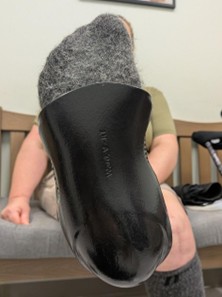
Mobility Barrier: Due to the fragile skin graft, Vicki could not tolerate any pressure on the surgical site and relied on a wheelchair. Before the AFO, she “could not walk at all! Could not put on bootie socks nor shoes.”
Surgical Reconstruction (Bony Fixation). Right ankle showing the new talus and Open Reduction Internal Fixation (ORIF) hardware.
Digital Workflow and AFO Prototyping
Given the severity of the trauma and the existence of an open, vulnerable skin graft wound, casting her limb conventionally was deemed impossible due to the risk of pressure and disruption to the healing tissue. This necessitated a sophisticated digital approach:
1. 3D Scanning (Non-Contact Capture)
On 8/26/2025 The patient’s affected limb was scanned using the Comb Scanner app on an iPhone. This provided a rapid, non-contact method to safely capture the exact contours of the complicated anatomy.
2. Data Editing
The scan data was processed to refine the file and convert it into a standard STL file for 3D printing.
3. Rationale for 3D-Printed Gauntlet
The choice of a 3D-printed gauntlet device was critical:
Wound Protection: It provided the necessary protection over the open wound.
Fit: 3D printing allowed for a low-profile design that would specifically fit inside the custom shoe without being too bulky.
4. Prototype Creation
The STL file was sent to Leopoly to create a prototype AFO file for initial design verification.
LeoAFO design process
AFO prototype made with LeoAFO
5. Final Brace Manufacturing
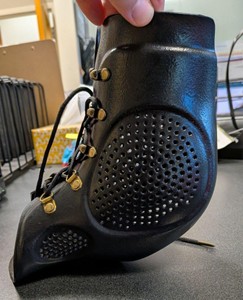
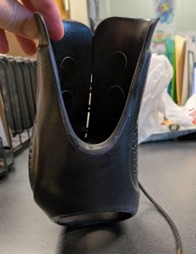
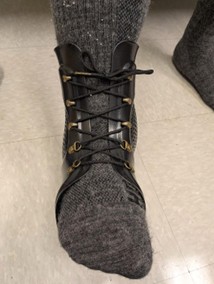
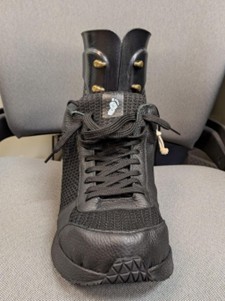
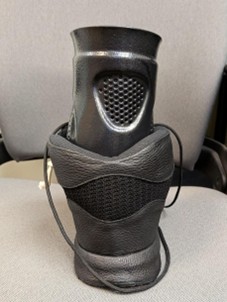
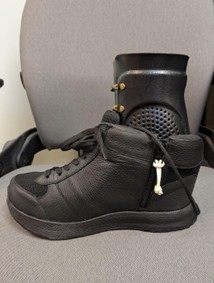
The STL file was then sent to Tillges for final production of the custom AFO. See images of the final AFO product (unworn) below.
front view of the finished AFO
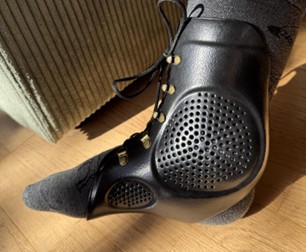
side view of the finished AFO, highlighting the ventilation and perforations
view from the bottom/heel of the finished AFO
Integrated Shoe and Brace Manufacturing
The 3D printed TPU AFO was trial fit on 9/29/2025. Crucially, the final AFO design uses a “cage” around the skin graft area to prevent any pressure or contact The custom AFO as designed would not fit into standard shoes, so an integrated manufacturing process was utilized:
Refined Scanning: A new scan was performed over the right foot + the prototype brace to ensure the shoe last would perfectly accommodate the entire system.
Custom Shoe Production: The finalized STL files were emailed to 3DFitShoes in Brazil to manufacture the custom high-top shoes.
Fit Verification: The shoes were fit on 10/16/2025 over the prototype brace.
The AFO itself was able to be further customized on 11/16/2025. The TPU device would not bend enough for rehab and therapy needs, reducing available foot and ankle ROM. The TPU trim lines were adjusted and material removed to allow more free ankle motion while still providing M/L stability and wound protection.
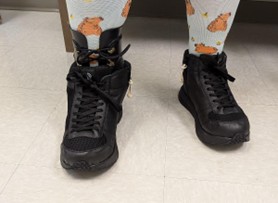
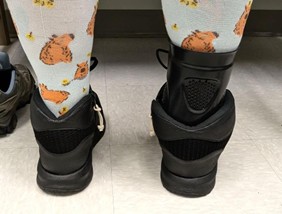
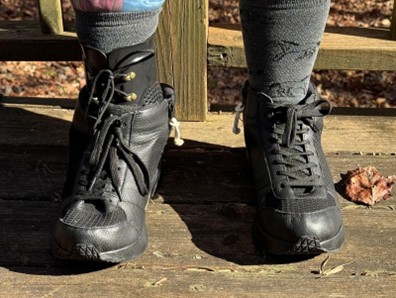
The custom AFO and shoe combination provides the stability and protection needed to transition Vicki from a wheelchair, to crutches, to independent walking. The AFO provides support to reduce pain and increase stability, allowing her to bear weight on the limb.She is becoming more and more confident that she can get out to go about her day, increasing her steps daily.
It also allows her to walk with a shoe instead of being barefoot or in a sock. This means that she can now walk her dog and venture out of her home. Driving is also safer and easier for her because the AFO provides necessary ankle support and eliminates the need to drive barefoot.
Vicki summarized the complex process and the life-changing results in one powerful sentence:
“The AFO has given me the freedom to resume my life!”
Vicki was exceedingly happy with the care and support she received, noting that the orthotist was “always available for any questions and prompt in his text replies.” Her success serves as a powerful example of modern orthotics overcoming catastrophic trauma using digital and collaborative manufacturing techniques.
About the Experts
Geof Tibbs, CO, CPA is a clinician and the Director of Cranial Remolding and Operations Manager at Tierney Orthotics & Prosthetics in Winston-Salem, NC. Geof has spent more than 12 years integrating 3D scanning, digital modeling, and additive manufacturing to his clinical practice. At Tierney, he leads an advanced cranial-remodeling program, combining precision laser scanning and data capture with the latest additive manufacturing and 3D printed design systems. Driven by innovation and human connection, Geof continues to work towards the next generation of orthotic care, where creativity, compassion, and computation meet to deliver freedom of motion.
Drew Meyer, MSPO, CPO, has eight years of experience in clinical orthotics and prosthetics and four years in medical device design, underpinned by a background in biomedical engineering. He holds degrees from the Colorado School of Mines and Baylor College of Medicine. Throughout his career in the O&P industry, Drew has held various roles, from staff practitioner, to clinic manager, and now developing and selling software solutions with Leopoly that enhance the designs and efficiency of orthotic and prosthetic care. To discuss how these design solutions can be applied to your specific clinical challenges, connect with Drew on LinkedIn.